IR Message from the President
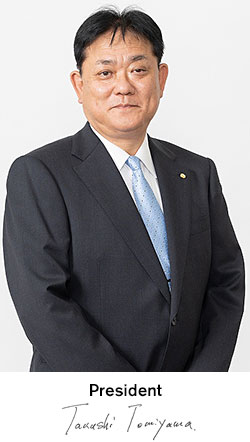
I am Takashi Tomiyama, the President of Nissan Shatai Co., Ltd.
In the fiscal year ending in March 2026, while the economy of Japan recovered moderately, it was necessary to pay attention to the impact of continued price rises on personal consumption, etc.Regarding the environment surrounding the Nissan Shatai Group, a situation continued in which we needed to pay close attention not only to indirect effects on the global economy due to trade issues, mainly led by the United States, but also to the impact of developments in the Middle East that occurred in the fourth quarter.
In this environment, the volume of vehicles from Nissan Motor Co., Ltd. increased by 5.6% compared to the same period last year to 154,668 units, mainly due to increased sales of the all-new Patrol and the all-new Armada, production of which commenced in the previous consolidated fiscal year, among other factors. Net sales increased by 15.2% to 403.8 billion yen due to the impact of the increase in the number of units, among other factors.
Looking at income and loss, operating income increased by 175.1% to 14.1 billion yen due to improved production efficiency, among other factors, in addition to the increase in the number of units. Ordinary income increased by 157.9% to 15.0 billion yen. In special gains and losses, an impairment loss on fixed assets of 2.6 billion yen and a provision for business restructuring of 2.1 billion yen were recorded as special losses in connection with the business conversion of the Shonan Plant to service parts production, the latter representing a reasonable estimate of costs associated with personnel measures targeting approximately 800 employees across the Group. As a result, profit attributable to owners of the parent increased by 127.3% to 6.8 billion yen.
In April 2023, Nissan Shatai launched a Medium-term Management Plan covering fiscal years 2023 to 2027. We have defined our Vision for our future as “Contribute to society through our commercial vehicles, premium cars, specially equipped vehicles, and support businesses, and become the one and only presence trusted by our customers,” and we are working to expand the following three major businesses.
In commercial vehicles and premium cars, we will continue to respond to diversifying customer needs and market requirements, improve quality and product added value, and increase our sales volume.
In our specially equipped vehicles business, we are working to expand sales by broadening our lineup beyond Nissan vehicles to cover a wide range, from kei cars to trucks manufactured by other manufacturers, while also strengthening our sales capabilities.
In our support businesses, we will continue to meet a wide range of customer needs by expanding the scope of our provision of experimental evaluation, design, and trial production services to include work commissioned from companies other than Nissan Motor.
In order to realize the aforementioned goals for our major businesses, the 2023-2027 Medium-term Management Plan focuses on three priority issues: “Sustainable corporate foundation,” “Creation of appealing products,” and “Evolution and deepening of uniqueness.”
The first pillar is a “Sustainable corporate foundation.”
Regarding initiatives for achieving carbon neutrality by 2050, we have implemented measures such as adopting LED lighting, visualizing power usage, and switching to “green power.”
Furthermore, we are actively working to utilize renewable energy, including the installation of solar panels on the roof of the headquarters’ main building.
Regarding our Diversity, Equity & Inclusion (DE&I) initiatives, we have continued to hold the “Eruboshi” certification, which can be earned by companies promoting the active participation of women, as well as the “Platinum Kurumin certification,” which is awarded to companies with particularly outstanding initiatives to support employees in balancing work and childcare.
Next is our second pillar, “Creation of appealing products.”
The full-size luxury SUVs manufactured at Nissan Shatai Kyushu continue to enjoy strong popularity, particularly in the Middle East and North America. In March 2026, the Patrol and the Armada received the world-renowned design award, the iF Design Award.
Furthermore, the all-new Elgrand, which is undergoing its first full model change in 16 years, achieves outstanding quietness, high fuel efficiency, and a comfortable ride through its third-generation e-POWER, e-4ORCE, and next-generation Active Noise Control.
Turning to commercial vehicles, in 2025, the Caravan has been enhanced with the addition of Intelligent Cruise Control and a 9-inch navigation system to support safety, security, and comfort, while the NV200 Vanette has been equipped with door mirrors with a “door-lock-linked folding function,” among other features.
In addition, Nissan Shatai and Auto Works Kyoto, a subsidiary specializing in specially equipped vehicles, planned and developed the “tabicafe,” an accommodation vehicle, which went on sale in 2026. Based on the Caravan, it features a bright interior and a spacious bed, creating a relaxing space where two people and their pet can enjoy a café atmosphere at their leisure inside the vehicle.
In the area of EV conversion, YAMATO Mobility & Mfg. Co., Ltd. and Auto Works Kyoto. Entered into a business partnership in October 2025 and launched a business to convert highly reliable Japanese-made used trucks into EVs, contributing to the promotion of environmental initiatives.
Next is the last pillar, “Evolution and deepening of uniqueness.”
Upon end of mass production of vehicles scheduled at the end of March 2027, the Shonan Plant will be converted into a service parts production facility. We are currently increasing production to respond to last-minute demand for the NV200 Vanette, and are working to ensure that we can deliver every last vehicle to our customers.
At Nissan Shatai Kyushu, we are conducting simulation analyses of the production line with the aim of improving capacity utilization, and working to achieve early improvements at bottleneck processes. Also, we will further reduce production losses by optimizing equipment maintenance and inspection.
As we enter the fourth year of the 2023-2027 Medium-Term Management Plan, as one united company, we are determined to earn even greater confidence among all of our stakeholders, including shareholders, customers, business partners, local communities, and employees.
June 2026
Consolidated Operating Results and Forecast
| FY2024 Actual |
FY2025 Actual |
|||
| Net sales (billion yen) |
350.5 | 16.4% | 403.8 | 15.2% |
| Operating income (loss) (billion yen) |
5.1 | 425.7% | 14.1 | 175.1% |
| Ordinary income (loss) (billion yen) |
5.8 | 319.9% | 15.0 | 157.9% |
| Profit (loss) attributable to owners of parent (billion yen) |
3.0 | 645.1% | 6.8 | 127.3% |
| Vehicle sales volume (thousand vehicles) |
146.5 | 5.3% | 154.6 | 5.6% |
About Consolidated Financial Results for FY2025
In the fiscal year ending in March 2026, while the economy of Japan recovered moderately, it was necessary to pay attention to the impact of continued price rises on personal consumption, etc.
Regarding the environment surrounding the Nissan Shatai Group, a situation continued in which we needed to pay close attention not only to indirect effects on the global economy due to trade issues, mainly led by the U.S., but also to the impact of developments in the Middle East that occurred in the fourth quarter.
In this environment, the volume of vehicles from Nissan Motor Co., Ltd. increased by 5.6% compared to the same period last year to 154,668 units, mainly due to increased sales of the all-new Patrol and all-new Armada, production of which commenced in the previous consolidated fiscal year, among other factors. Net sales increased by 15.2% to 403.8 billion yen due to the impact of the increase in the number of units, among other factors.
Looking at income and loss, Operating income increased by 175.1% to 14.1 billion yen due to improved production efficiency, among other factors, in addition to the increase in the number of units. ordinary income increased by 157.9% to 15.0 billion yen.In special gains and losses, an impairment loss on fixed assets of 2.6 billion yen and a provision for business restructuring of 2.1 billion yen were recorded as special losses in connection with the business conversion of the Shonan Plant to service parts production, the latter representing a reasonable estimate of costs associated with personnel measures targeting approximately 800 employees across the Group. As a result, profit attributable to owners of the parent increased by 127.3% to 6.8 billion yen.
