Human Resource Development
Policy on Human Resource Development and Compensation
Nissan Shatai Group arranges training operations for individuals to attend classes in accordance with their growth. These training activities range from basic knowledge needed in the work world to cultivation of management human resources with broad understanding.
Furthermore, with the aim of fostering a culture of constant improvement, Nissan Shatai Group strongly promotes improvements in product and work process quality via QC circle activities in skilled workplaces and also conducts activities that visualize and resolve issues and Quality Function Deployment (QFD) activities that utilize a quality function deployment methodology in administrative and technology workplaces. It puts efforts into skill education to enhance work efficiency in which employees prepare their own program utilizing management and facilitation capabilities required for managerial positions and digital tools.
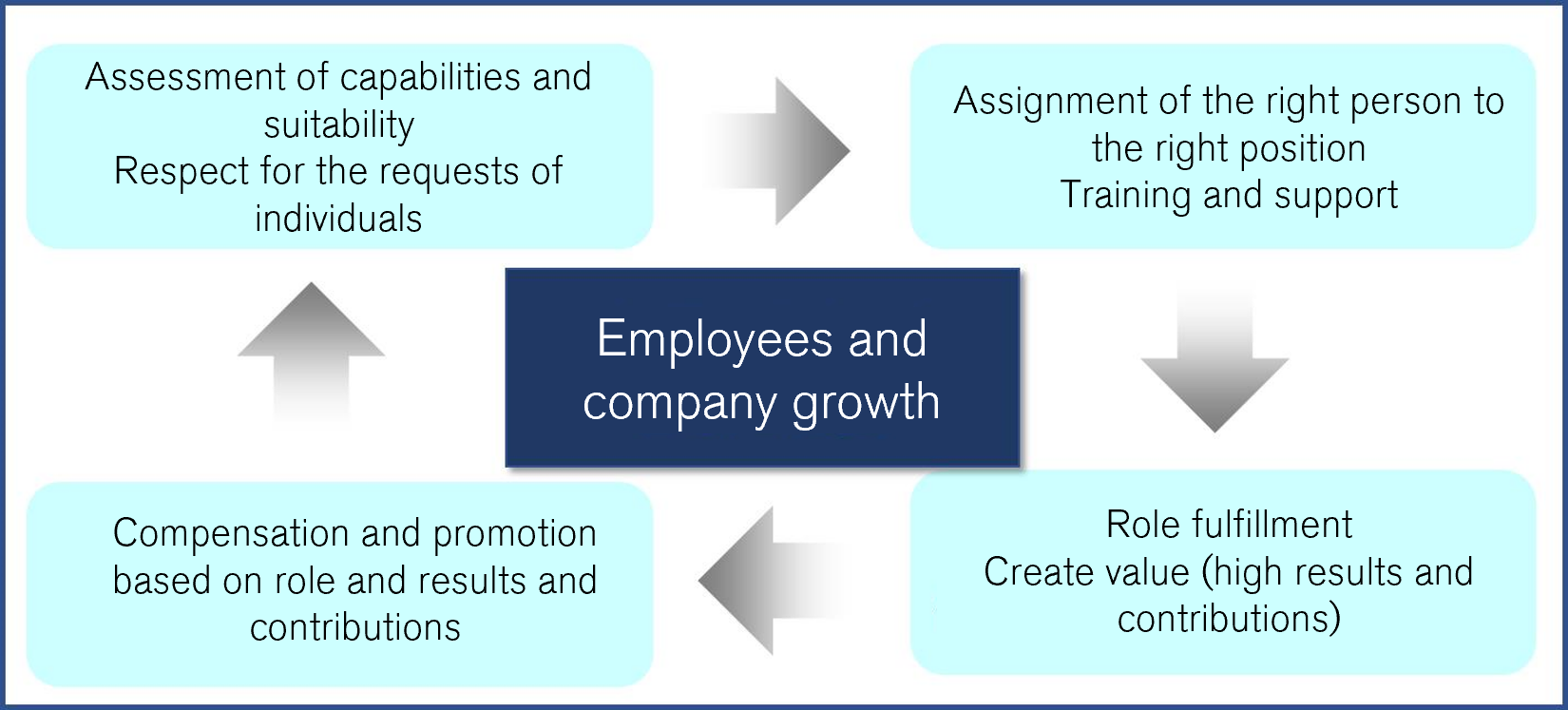
The personnel evaluation system promotes employee and company growth by adopting fair and transparent personnel evaluations and basing compensation on employee performance and contributions.
Furthermore, the internal awards program recognizes employee efforts and results with the aim of boosting enthusiasm and motivation.
Our system is built around the concept of “competency” (behavioral characteristics, skills, and knowledge that lead to visible results), with four mechanisms serving as its core pillars. Competency serves as a “guide for employee development and career advancement” and as an “evaluation standard.”
Each year, employees set goals and are evaluated according to their degree of achievement.
| Four Pillars | Aim |
|---|---|
| Role Grading System by Career Course | A guideline for growth and career advancement |
| Evaluation System | To fairly evaluate employees’ “demonstrated capabilities” and “performance” |
| Compensation System | To reward employees for their “demonstrated capabilities” and “performance” |
| Career Development | To support employees’ growth and career development |
Training System Overview
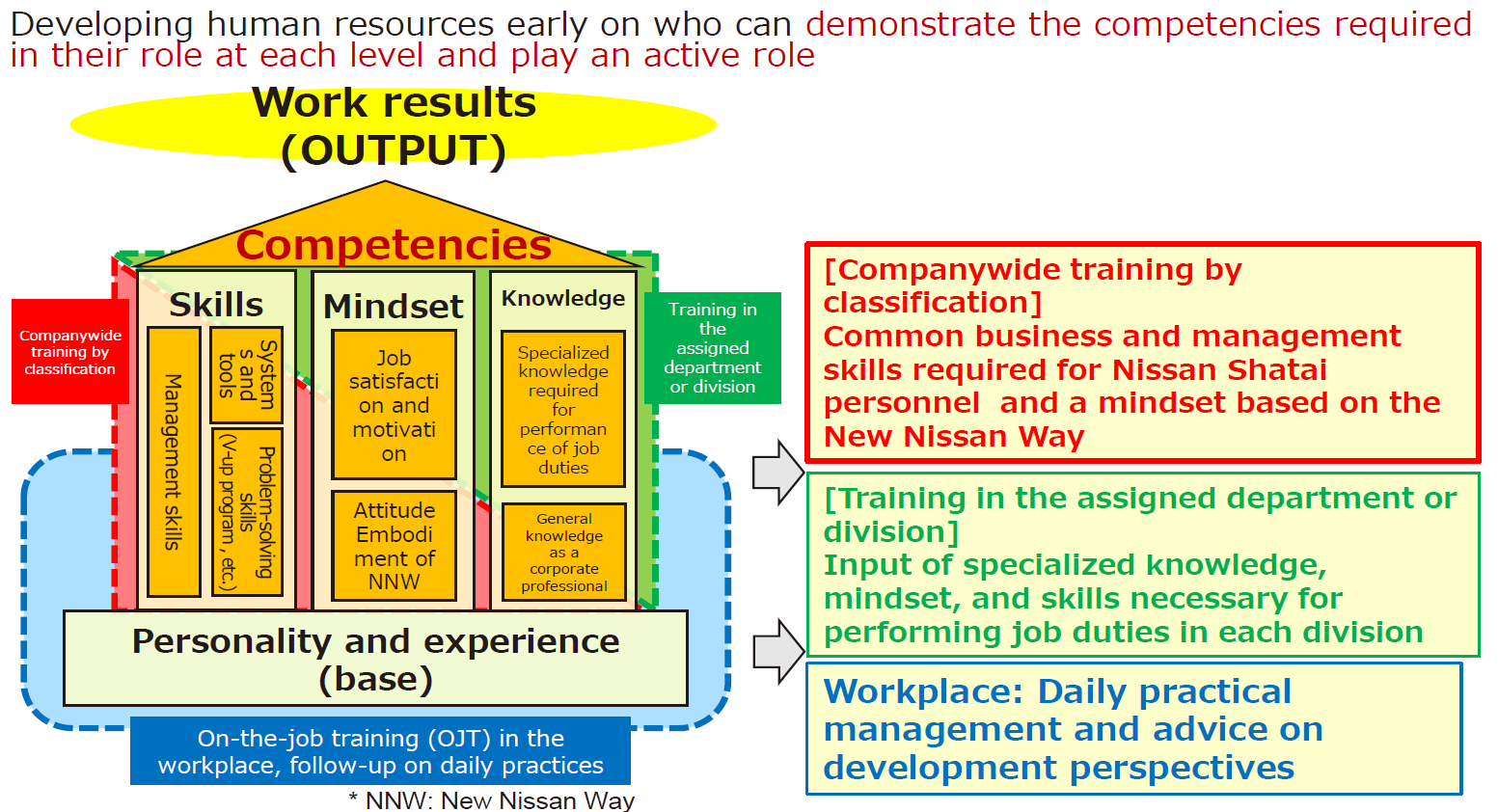
The structure of Nissan Shatai's training system is as shown in the diagram. First, the goal is to develop human resources early on who can demonstrate the competencies required in their role at each level, deliver output, and play an active role. Based on this goal, we focus on developing three pillars: skills, mindset, and knowledge, along with the foundational elements of personality and experience. The blue area represents competencies developed through on-the-job training (OJT) and daily support at the workplace. The green and red areas represent internal training and education. The red area represents competencies essential for working at Nissan Shatai, conducted as companywide education for all employees. The green area covers department-specific training necessary for performing duties at each division. By combining these aspects, we aim for the early development of human resources who can excel at Nissan Shatai. Additionally, training includes self-development programs employees can choose to take. Overall, we offer over 60 types of training, providing highly comprehensive support.
For advanced specialized human resource education, we implement training programs in which employees who already hold national qualifications such as automotive mechanic certifications and national skill certifications provide direct instruction to other employees seeking to acquire these qualifications, and we have established support systems for qualification acquisition.
New employee seminar
First-year schedule
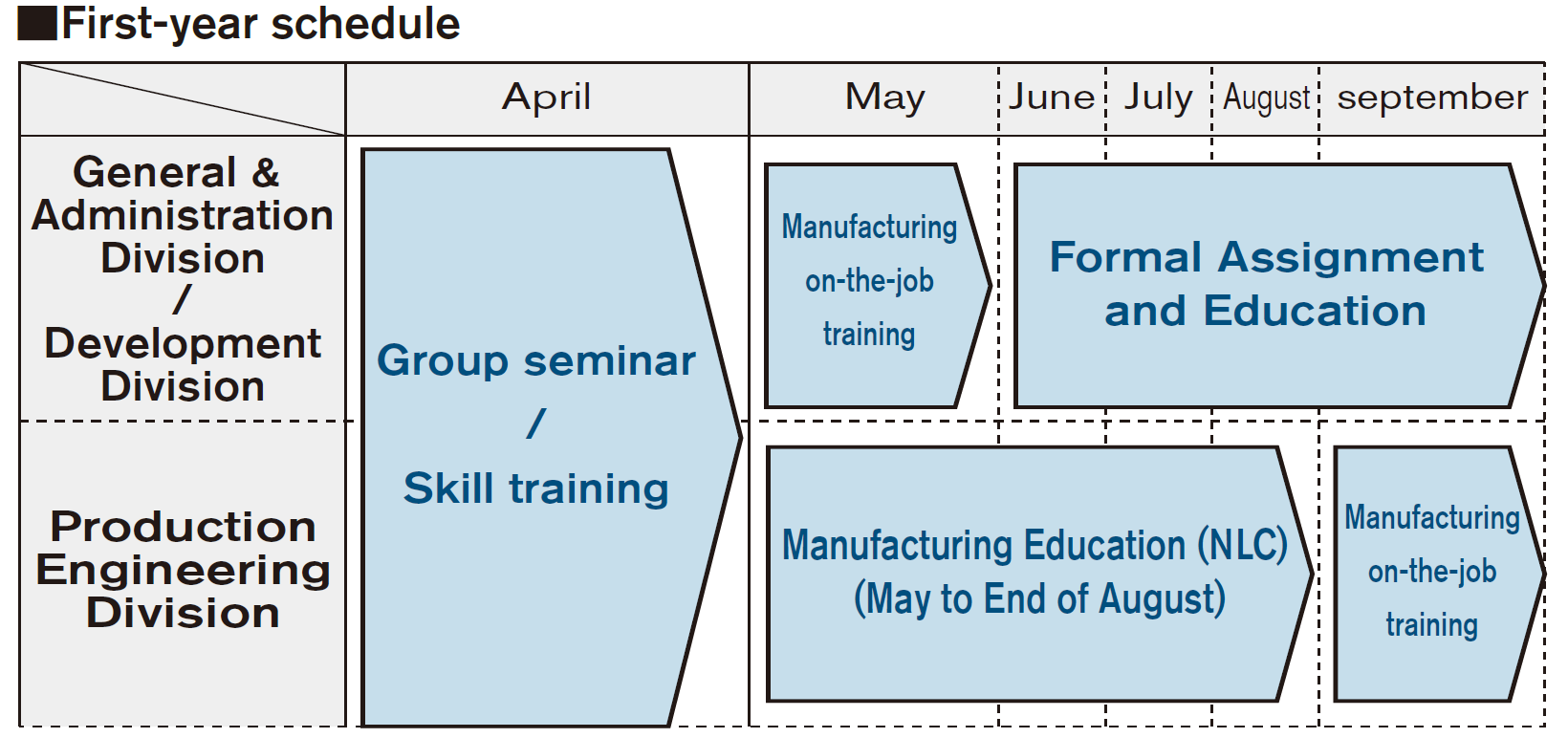
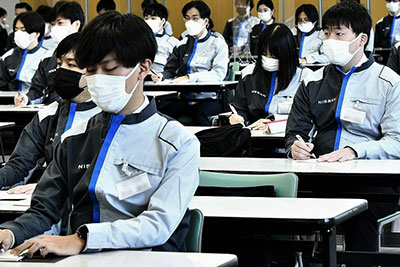
New employees participate in an approximately two-week group seminar followed by skills training in preparation for manufacturing on-the-job training. After completing the basic skills training, they conduct on-the-job training at a plant for one month. By joining an actual production line, new employees learn the appeal and challenges of manufacturing. New employees assigned to development or administrative departments will be formally assigned to their workplaces starting in June. Those assigned to production departments will participate in group training at Nissan Motor's training facility before proceeding to manufacturing on-the-job training, followed by formal job assignment.