Materiality (Key issues)
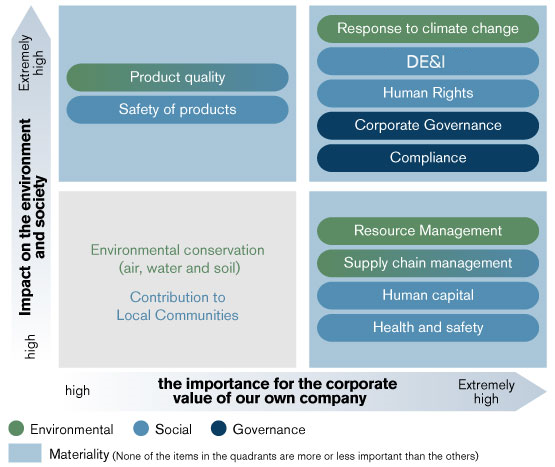
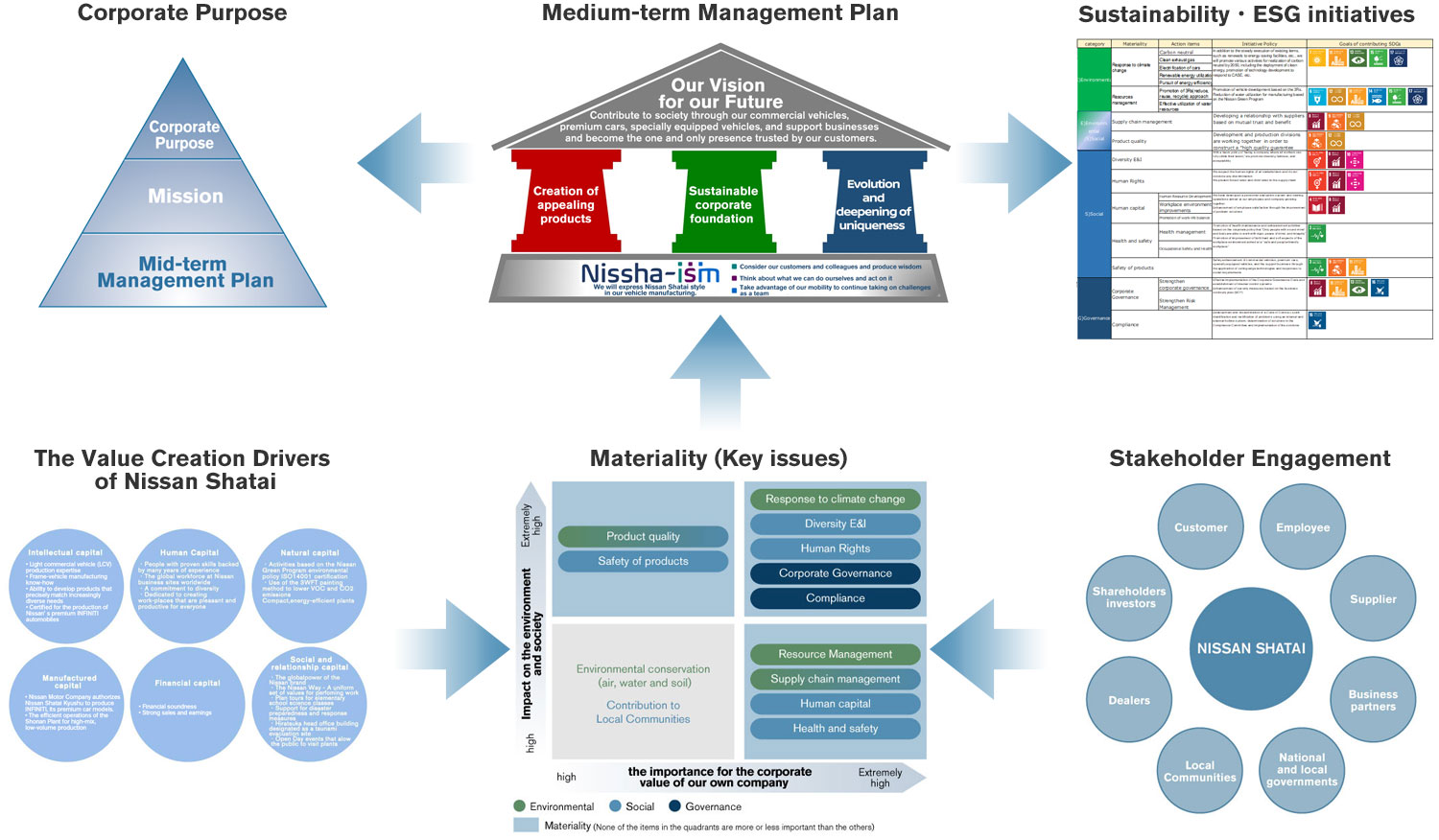
Of the 13 items extracted with the purposes of the sustainable growth of the company and the realization of a sustainable society through ESG initiatives and contribution to the SDGs for global environmental and social issues, we specified 11 items as Materiality (Key issues) which Nissan Shatai should give top priority to tackling.
Based on the concept of double materiality, we organized a matrix on the two axes of “the impact on the environment and society” and “the importance for the corporate value of our own company.”
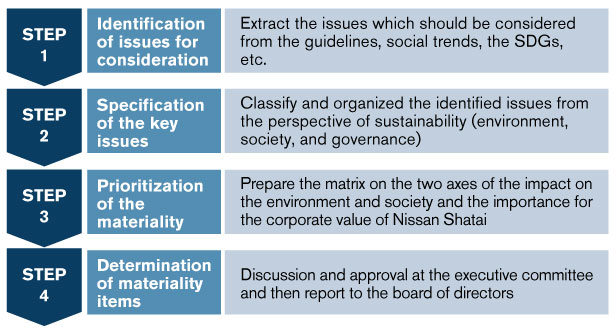
The process for determining Materiality (Key issues)
Initiatives for materiality (key issues) and SDGs goals, and risks and opportunities
| category | Materiality | Action items |
Initiatives | Goals of contri- buting SDGs |
Main risks |
Main opportu nities |
Reasons for selection |
|---|---|---|---|---|---|---|---|
| E)Envi- ronmental |
Response to climate change | Carbon neutral | In addition to the steady execution of existing items, such as renewals to energy-saving facilities, etc., we will promote various activities for realization of carbon neutral by 2050, including the deployment of clean energy, promotion of technology development to respond to CASE, etc. Nissan Shatai has set a target of reducing CO2 emissions per unit by 52% by 2030, compared to FY2018, and is advancing initiatives such as switching to LED lighting, visualizing electricity usage, and transitioning to “green power.” As part of this, in 2025, we installed solar panels on the roof of the headquarters’ main building. |
|
Plant disaster accompanying abnormal weather related to hotter temperatures, increased natural disasters due to climate change, cost increases due to regulatory strengthening, increase in energy costs due to deployment and expansion of a carbon tax | Introduction of renewable energy, development of low-carbon technology | As natural disasters caused by climate change intensify and international calls for the transition to a decarbonized society grow, the automotive industry is also required to reduce CO2 emissions. |
| Clean exhaust gas | |||||||
| Electrification of cars | |||||||
| Renewable energy utilization | |||||||
| Pursuit of energy efficiency | |||||||
| Resources management | Promotion of 3Rs(reduce, reuse, recycle) approach | Promotion of vehicle development based8 on the 3Rs. Reduction of water utilization for manufacturing based on the Nissan Green Program To reduce environmental impact across the entire supply chain, we share Nissan’s procurement policy and environmental philosophy with our suppliers of automotive parts and materials, and work together on activities including quality control and material management. |
|
Rise in raw material prices, supply anxiety due to resource depletion, strengthening of environmental regulations | Promotion of resource efficiency, development of recycling technology, sustainable resource procurement | Amid growing calls to address resource constraints and waste issues, it is necessary to reduce environmental impact through the effective utilization of resources and contribution to a circular economy. | |
| Effective utilization of water resources | |||||||
| E)Envi- ronmental/ S)Social |
Supply chain management | With the aim of resolving and preventing social and environmental issues in business, the Nissan Group has established the Nissan Supplier Sustainability Guidelines and has been exchanging confirmation documents with suppliers. |
  |
Severing of the supply chain by abnormal weather, issues with suppliers’ working environments | Improvement in supply chain transparency, sustainable procurement, strengthening of cooperative relationships with suppliers | The risk of supply chain disruption due to geopolitical risks, natural disasters, and material shortages is increasing, making it essential to achieve both stable and responsible procurement. | |
| Product quality | Development and production divisions are working together in order to construct a “high quality guarantee process.” |
|
Recalls due to quality issues, decline in brand image, customer attrition | Improvement in brand value through quality enhancement, improvement in customer satisfaction, increase in repeat customers | To earn customer trust and maintain brand value, it is necessary to continuously provide high-quality products and minimize risks related to market quality. | ||
| S)Social | Diversity, equity & inclusion | With a basic policy of “being a company where all workers can fully utilize their tarent,” we promote diversity, fairness, and acceptability With a target of raising the ratio of women in managerial positions to 10%, we are working to build a supportive corporate culture and design the necessary systems to achieve this goal. We continue to maintain our “Platinum Kurumin” and “Eruboshi” certifications. |
  |
Human resource outflow due to lack of diversity, legal issues, social criticism | Innovation through utilization of diverse human resources, improvement in corporate culture, improvement in brand image | Developing a workplace environment in which diverse human resources can demonstrate their abilities, and linking this to securing human resources, revitalizing the organization, and creating innovation, is an important factor in enhancing corporate competitiveness. | |
| Human Rights | We respect the human rights of all stakeholders and do not condone any discrimination. We prevent forced labor and child labor in the supply chain |
|
Legal issues due to human rights violations, decline in brand image, social criticism | Improvement in corporate evaluation through respect for human rights, strengthening of competitiveness in global markets, improvement in brand image | As international calls for respect for human rights grow, it is necessary to prevent human rights violations not only within the company but across the entire supply chain, and to promote responsible business activities. | ||
| Human capital | Human Resource Development | We have developed a personnel evaluation system and training operations aimed at our employees and company growing together Enhancement of employee satisfaction through the improvement of problem solutions To promote flexible working styles, we have introduced a flextime system and remote working (working from home). |
 |
Human resource outflow, resource shortage, skill gaps, decline in employee morale | Improvement in employee skills through education and training, enhanced employee engagement, increased employee motivation | To respond to technological innovation and changes in the business environment, it is necessary to support employees’ capability development and career formation, and to continuously improve organizational capabilities. | |
| Workplace environment improvements | |||||||
| Promotion of work-life balance | |||||||
| Health and safety | Health management | Promotion of health maintenance and enhancement activities based on the corporate policy that “Only people with sound mind and body are able to work with vigor, peace of mind, and integrity” Promotion of improvement of both hard and soft aspects of the workplace environment aimed at a “safe and people-friendly workplace” |
 |
Industrial accidents, productivity decline due to health issues, legal issues | Enhancement of productivity through provision of healthy workplace environment, improved employee satisfaction, enhanced corporate evaluation | The safety and health of employees form the foundation of business activities. By preventing occupational accidents and promoting health management, we aim to enhance job satisfaction and productivity. | |
| Occupational Safety and Health | |||||||
| Safety of products | Safety enhancement of commercial vehicles, premium cars, specially equipped vehicles, and the support business through the application of cutting-edge technologies and responses to social requirements |
|
Legal issues, decline in brand image, decline in social credibility | Gaining of customer trust through provision of highly safe products, enhanced brand value, increase in repeat customers | As an automobile manufacturer providing products that are directly related to human life, we make ensuring safety performance as our top priority and provide products that customers can use with peace of mind. | ||
| G)Gover- nance |
Corporate Governance | Strengthen corporate governance | Effective implementation of the Corporate Governance Code and establishment of internal control systems Enhancement of security measures based on the business continuity plan (BCP) |
 |
Management instability due to governance dysfunction, decline in investor confidence, decline in corporate value | Stable management through transparent and efficient governance, gained investor trust, enhanced corporate value | By ensuring transparency and fairness in management, and by making prompt and appropriate decisions, we aim to enhance corporate value over the medium to long term. |
| Strengthen Risk Management | |||||||
| Compliance | Development and dissemination of a Code of Conduct, quick identification and rectification of problems using an internal and external hotline system, determination of solutions in the Compliance Committee and implementation of the solutions |
|
Penalties due to legal violations and their responses, decline in corporate value, social criticism | Enhancement of corporate value through legal compliance, strengthened legal compliance functions, maintained and gained social trust | Violations of laws and regulations or misconduct can lead to a loss of corporate trust and risks to business continuity; therefore, it is necessary to thoroughly conduct business activities based on high ethical standards. | ||
Value Creation Process
*Click to zoom
